01
Blinds: adjustable hard slats
Blinds use horizontal or vertical slats that tilt to redirect daylight and sightlines. Wood adds natural grain; faux wood offers a practical material choice for active or moisture-conscious rooms; aluminum is compact and crisp; vertical vanes move naturally with sliding doors. Slat gaps mean blinds are not sealed blackout systems.
02
Shades: fabric or cellular planes
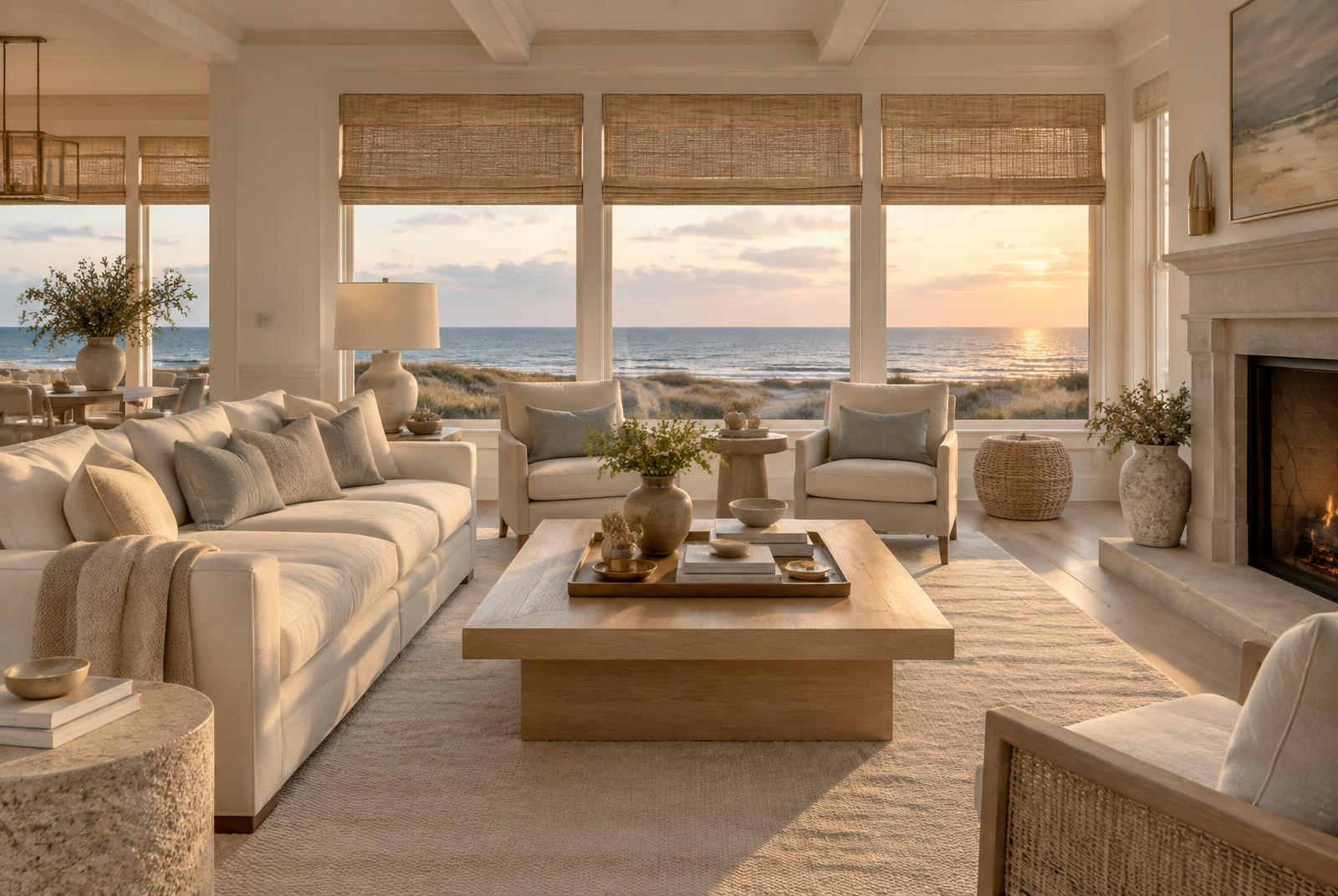
Shades raise and lower as a continuous material. Roller and solar shades can be visually quiet, Roman and woven shades add textile character, and cellular shades create a compact pleated layer. Fabric opacity ranges from sheer to blackout, but installation gaps still influence privacy and darkness.
03
Shutters and drapery: architecture and softness
Interior shutters place framed, adjustable louvers within the opening and read as a permanent architectural element. Drapery travels beside or across the window, bringing softness, fullness, and useful edge coverage. Either can stand alone or support another functional layer.
04
Film: an adjacent glass solution
Film adheres to the glass rather than operating like a treatment. Solar film can remain active without covering the view; decorative film can create permanent privacy. Reflective film does not provide dependable true one-way privacy at night when the interior is brighter. Film is not blackout, and security film is a separate glass-retention and forced-entry-delay category.
05
Choose by the hardest requirement
Start with the moment that exposes the problem: afternoon glare, bedtime darkness, evening privacy, strong sun on furnishings, or a door that must remain passable. Then compare operation, maintenance, mounting space, architecture, and budget. Product names come after the room’s requirements.
Decision table
Compare the practical tradeoffs.
| Category | How it controls the window | Best starting point for |
|---|---|---|
| Blinds | Tilting slats | Adjustable light and sightlines |
| Shades | Raises or lowers a material plane | Broad design range and room-darkening |
| Shutters | Fixed frame with movable louvers | Built-in character and privacy |
| Drapery | Traversing textile panels | Softness, layering, and edge coverage |
| Window film | Always-active layer on glass | View-preserving solar, glare, UV, or permanent privacy goals |
A window treatment is not a style label—it is a system for controlling the relationship between glass, light, privacy, and the room.