View + evening privacy
Use solar-control film for daytime comfort and a light-filtering or privacy shade for night.
A candid comparison
Film and window treatments solve overlapping problems in very different ways. We look at the glass, the view, the time of day, and the level of control you actually need.
At a glance
| Solution | Glare & solar comfort | View | Privacy | Room-darkening | Control |
|---|---|---|---|---|---|
| Solar control film | Excellent | Preserves it | Daytime only, depending on conditions | No | Always active |
| Solar shades | Very good | Filtered through fabric | Adjustable; strongest when closed | Limited | Manual or motorized |
| Blackout shades | Good when closed | Covered | Strong when closed | Best option | Manual or motorized |
| Blinds | Adjustable | Partial through tilted slats | Adjustable | Not complete | Manual; some motorized |
| Shutters | Adjustable | Partial through louvers | Strong and adjustable | Room-darkening, not blackout | Manual |
The nighttime reality
When it is brighter inside than outside, reflective film generally cannot provide true one-way nighttime privacy.
For adjustable privacy after sunset, use a shade, blind, or shutter. For permanent privacy where the view is not needed—such as sidelights, bathrooms, or interior partitions—decorative or frosted film may be appropriate.
From the field · Real window conditions
These photos are from Shore Tint & More glazing and window-film jobs, Delaware Shade Co.’s sister brand. They are not Delaware Shade Co. shade or blind installations.
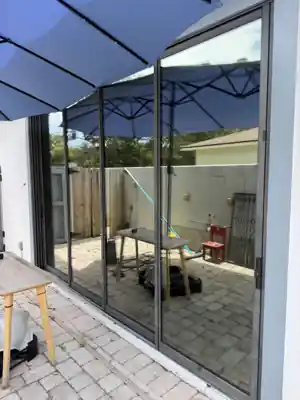
Reflective patio glass
In daylight, reflective film makes glass read as a mirror from outside. That changes at night when the interior is brighter than outside.
Reflective film is not dependable one-way privacy after dark. A shade or other opaque layer is still needed for nighttime privacy.
Where film excels
Solar film can reduce heat, glare, and UV exposure without placing a product in front of the window.
That makes it especially useful for view-sensitive living spaces, broad coastal glass, and commercial façades. Performance varies by film, glass, orientation, and conditions; specification matters.
Better together
Use solar-control film for daytime comfort and a light-filtering or privacy shade for night.
Use film to moderate exposure, then a blackout system with considered side channels or overlap for darkness.
Use film or solar shades for daily glare, with room-darkening shades where screens and presentations require it.
Use frost film where permanent privacy is welcome; add an operable treatment only if softness or darkness is also wanted.
A separate category
Security film is a glass-retention and forced-entry-delay solution. It is specified for a different purpose than solar or decorative film, and should be considered as part of a broader opening and security strategy.
Learn the whole vocabulary
See how blinds, shades, shutters, drapery, and architectural film differ before choosing a layer.
Read the cornerstone guidePrivate, in-person guidance