Privacy solutions

Privacy should change with the hour.

For reliable privacy after dark, use an operable opaque treatment. Solar and sheer fabrics can preserve daylight but are not dependable nighttime privacy when the room is brighter than outside.

Layered bedroom treatments designed for privacy

The essential details

Make the decision from the goal backward.

01

Adjustable privacy

Blinds and shutters redirect sightlines; privacy roller, Roman, cellular, and lined woven shades close the view more fully.

02

Permanent privacy

Frosted or decorative film is useful where the view is not needed, including sidelights, baths, and interior glass.

03

Day and night

A dual layer can pair a view-preserving solar shade by day with an opaque treatment at night.

A strong fit

Consider this when…

  • Street-facing rooms
  • Bedrooms and baths
  • Glass doors and close neighbors

Look again

Another answer may be better when…

  • Reflective film as promised one-way nighttime privacy
  • Open-weave fabric as the only evening layer
  • Blackout assumptions without checking gaps

Specification notes

Details that change the result.

Sightlines

Assess privacy from the actual exterior approach and neighboring height, not only from straight across.

Light

Top-down shades can preserve sky light while covering eye-level views.

Doors

Handles, swing, and hold-downs affect treatment selection on glazed doors.

For commercial projects

Specifying this for an office, school, healthcare, or hospitality project? Office window shades

From the field · Real window conditions

What the glass actually looks like.

These photos are from Shore Tint & More glazing and window-film jobs, Delaware Shade Co.’s sister brand. They are not Delaware Shade Co. shade or blind installations.
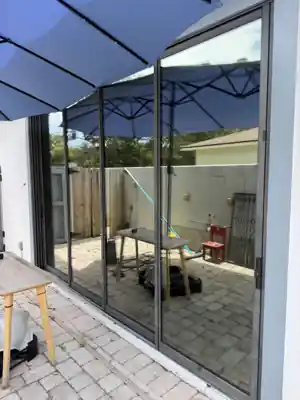
Large sliding patio glass doors from a Shore Tint & More job, reflecting a patio umbrella and sky in daylight

Reflective patio glass

In daylight, reflective film makes glass read as a mirror from outside. That changes at night when the interior is brighter than outside.

Reflective film is not dependable one-way privacy after dark. A shade or other opaque layer is still needed for nighttime privacy.

From the journal

Read the decision in more depth.

Product Comparisons · 6 min

Blinds vs Shades: What’s the Difference?

Blinds adjust with hard slats. Shades move a continuous textile or cellular surface. That basic construction changes the experience.Read the guide

Product Comparisons · 6 min

Wood Blinds vs Faux Wood Blinds

Real wood leads with grain and lighter weight. Faux wood leads with practical resilience. Width and moisture often decide.Read the guide

Room & Window Type · 7 min

Best Window Treatments for Bedrooms

A bedroom treatment should answer three moments: waking daylight, evening privacy, and the darkness needed for sleep.Read the guide

Frequently asked

A few useful answers.

Does reflective window film provide privacy at night?+

Generally not when the inside is brighter than outside.

What gives the strongest adjustable privacy?+

An opaque shade or well-closed shutter or blind provides strong adjustable coverage; exact gaps vary by system.

Can bathroom glass stay bright and private?+

Decorative film or a top-down treatment can preserve daylight while limiting views.

Private, in-person guidance

See the material in your own light.

Request a consultation